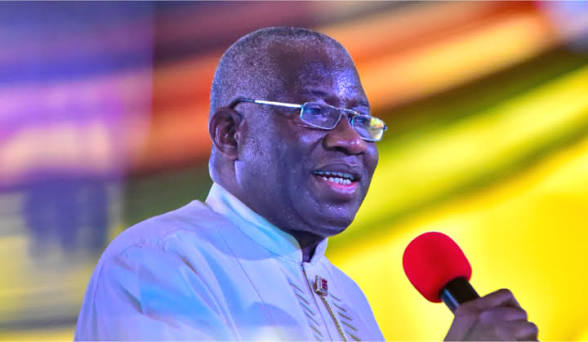
Former President Goodluck Jonathan has identified leadership failures, divisive political considerations, corruption and weak institutions as major factors responsible for Nigeria’s persistent development challenges.
Jonathan said the country would continue struggling to achieve meaningful progress unless it moved away from selecting political leaders based on religion, ethnicity, language and other sectional considerations.
He made the remarks on Saturday, November 14, while chairing the Herbert Macaulay Memorial Colloquium in Lagos, organised to commemorate the 162nd anniversary of the birth of the nationalist pioneer.
The former president argued that Nigeria’s political recruitment process has continued to undermine the emergence of capable leaders, stressing the need to prioritise competence, character and capacity over religious and ethnic affiliations.
He illustrated the problem with an example from a state in southern Nigeria where, according to him, religious denomination could determine whether an individual was considered eligible to become governor, regardless of the person’s qualifications.
Jonathan warned that the country could not achieve meaningful development while such considerations continued to influence political leadership selection.
Beyond the political recruitment process, he identified institutional weaknesses, corruption, inconsistent government policies, inadequate infrastructure, insecurity and excessive dependence on raw material exports as other challenges restricting national development.
Comparing Nigeria’s development trajectory with those of India, Singapore and South Korea, Jonathan observed that the countries had made considerable progress in industrialisation, technology, education and healthcare by investing in their human capital and strengthening institutions.
He particularly emphasised the importance of functional education, arguing that Nigeria needed universities capable of producing research, innovation and technological advancement rather than institutions focused predominantly on conventional academic qualifications.
According to him, the country must deliberately invest in its brightest minds and develop world-class universities capable of competing internationally.
“You can’t go anywhere with weak educational institutions,” he said.
Jonathan also called for comprehensive reforms of Nigeria’s democratic system, describing its current structure as opaque and amorphous.
He advocated stronger popular participation, judicial independence, respect for human rights, accountability, the rule of law and a vibrant civil society as essential components of a functional democracy.
Looking towards Nigeria’s 100th anniversary of independence in 2060, the former president urged the present generation to develop a clear national development agenda that would prevent future generations from inheriting the same challenges.
He also called for greater attention to preserving the country’s history and national monuments, noting that understanding the sacrifices and contributions of founding nationalists remained important to building a united nation.
Jonathan said celebrating national heroes should go beyond commemorative events and involve building a country that reflects the ideals and aspirations for which they fought.
The colloquium examined the legacy of Herbert Macaulay, one of Nigeria’s prominent nationalist figures, whose political activism and advocacy for self-determination contributed to the country’s struggle against colonial rule.