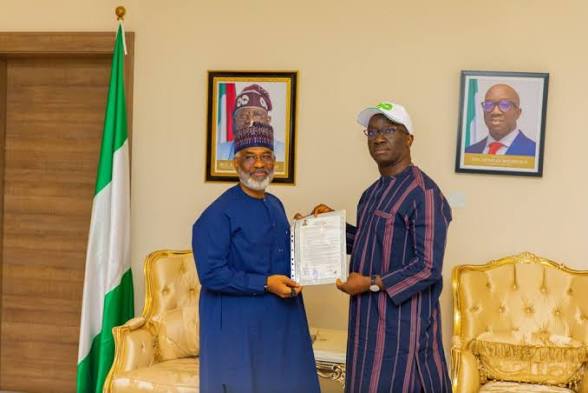
The Edo State Government has taken another step towards establishing a refinery in the state with the presentation of a Certificate of Occupancy (C-of-O) to the Nigerian National Petroleum Company Limited (NNPC Ltd.) for its proposed Oredo Refinery and Petrochemical Company.
The certificate was presented by Governor Monday Okpebholo to the NNPC delegation during a courtesy visit to the Edo State Government House in Benin City on Friday, November 13.
NNPC’s Executive Vice President, Downstream, Alhaji Mumuni Dagazau, received the document on behalf of the national oil company.
The development provides the company with an important land documentation requirement for the proposed investment, although the presentation of the certificate does not in itself mean that construction has commenced.
Dagazau commended the Edo Government for providing the land and the necessary documentation, describing the gesture as evidence of the administration’s commitment to attracting investments capable of expanding the state’s productive economy.
He said the proposed refinery aligned with the Federal Government’s Renewed Hope Agenda, particularly its objectives of strengthening domestic energy security, reducing dependence on imported petroleum products and increasing local value addition.
According to him, the project is expected to strengthen Nigeria’s refining capacity and create opportunities across the downstream petroleum industry.
He identified employment generation, technology transfer, increased local participation and industrial development among the potential benefits of the investment.
Dagazau assured the state government that NNPC would work with relevant stakeholders to provide the necessary support for the successful delivery of the project.
He expressed confidence that the proposed facility would contribute to Edo’s economic growth while supporting efforts to improve Nigeria’s domestic energy supply.
Presenting the certificate, Governor Okpebholo reaffirmed his administration’s commitment to creating an enabling environment for businesses and investors.
He said the provision of land and the necessary documentation formed part of deliberate efforts to attract investments, expand the state’s revenue base and generate employment opportunities for residents.
The governor described the proposed refinery as an important investment that could strengthen Edo’s commercial and industrial base.
He also assured NNPC of the state government’s continued cooperation, stressing that his administration was prepared to support projects capable of contributing to economic development.
The latest development follows an earlier announcement in February 2026 that the Edo State Government and NNPC had agreed to collaborate on a 10,000-barrel-per-day condensate refinery project.
At the time, the Federal Ministry of Information and National Orientation disclosed that the proposed facility would be located across Oredo and Orhionmwon Local Government Areas.
The February announcement projected a completion period of between 24 and 36 months and estimated that the refinery could produce approximately 20 truckloads of Premium Motor Spirit, commonly known as petrol, and 10 truckloads of Automotive Gas Oil, or diesel, daily when operational.
The project was presented as part of efforts to expand domestic refining capacity, strengthen fuel availability and stimulate industrial activities in the South-South region.
However, the latest announcement concerning the presentation of the Certificate of Occupancy did not provide an updated construction timetable, project cost, confirmed processing capacity or commencement date.
It is therefore not yet clear from the latest disclosure when construction activities will begin or when the facility is expected to commence operations.
The distinction is important because securing land documentation represents a project-development milestone, but the actual delivery of a refinery also requires financing, engineering, procurement, construction and the necessary regulatory approvals.
The proposed investment could have wider implications for Edo’s economy if successfully implemented.
A refinery operating in the state could create direct employment during construction and operations, while also generating business opportunities for contractors, transport operators, equipment suppliers and other service providers.
The project could further encourage the development of supporting industries around its location, particularly businesses involved in petroleum distribution, maintenance, logistics and industrial services.
For the wider Nigerian economy, additional domestic refining capacity could contribute to efforts to reduce reliance on imported petroleum products. However, the extent of its impact would depend on the facility’s eventual capacity, operational efficiency, feedstock supply and distribution arrangements.
The NNPC delegation at Friday’s meeting also included Ikedichi Dick-Nwoke, Chief Downstream Investment Officer; Adaobi Oniwinde, Senior Communications Adviser; and Valentine Marinho, Senior Business Analyst to the Executive Vice President, Downstream.
The presentation of the C-of-O marks a further stage in the proposed partnership between the Edo Government and the national oil company.
With the land documentation now presented, attention will turn to the next stages of project development, including the confirmation of implementation timelines and the commencement of construction.
For residents and businesses in Edo State, the proposed refinery represents a potential source of employment and industrial expansion. Its eventual economic contribution, however, will depend on the project’s transition from planning and land documentation to actual construction and commercial operations.