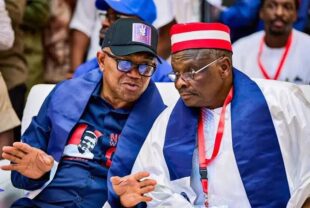

The rift between Nigeria’s two central labor unions has widened significantly following a sharp rebuke from the President of the Trade Union Congress (TUC), Comrade Festus Osifo, directed at Joe Ajaero, President of the Nigeria Labour Congress (NLC).
The dispute centers on the recently announced ₦70,000 monthly transport intervention allowance approved by the Federal Government for public sector workers over a six-month period—an arrangement negotiated principally between the government and NLC leadership.
Responding to statements by Ajaero asserting that the NLC could negotiate independently on behalf of workers, Osifo countered that no single labor center possesses the legal or procedural mandate to negotiate on behalf of another union’s members without explicit consultation or representation.
”You cannot negotiate for a body that is represented, for a body that has a trade union. You cannot negotiate for them on their behalf! It is not there anywhere,” Osifo stated, pointing out that while the NLC commands approximately 60 affiliate unions to the TUC’s 40, both organizations must act jointly during national labor negotiations.
Osifo challenged the legitimacy of the process, alleging that key organs like the Joint National Public Sector Negotiating Council (JNPSNC) were improperly bypassed. He claimed that the session yielding the allowance lacked a statutory quorum and excluded essential council members and TUC representatives.
Furthermore, Osifo criticized the structural application of previous wage adjustments, accusing the NLC leadership of implementing blanket flat-rate increases rather than engaging in proper consequential adjustment calculations. According to the TUC chief, applying flat additions across the board rather than percentage-based adjustments has negatively affected the relative earning power of senior public servants.
The TUC maintains that rather than temporary relief measures, the focus should remain on comprehensive salary overhauls and collective bargaining agreements that include all organized labor stakeholders.
You Might Also Like