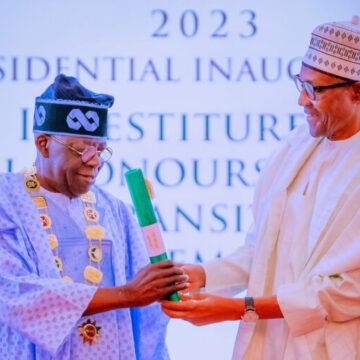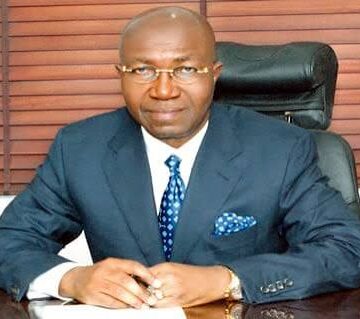
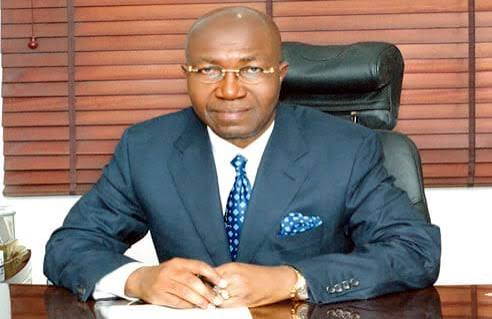
Renowned Senior Advocate of Nigeria Chief Wole Olanipekun has disclosed that President Bola Tinubu openly declared his ambition to govern Nigeria as far back as 1992 while serving as a senator. Olanipekun made the revelation in Abuja at the Body of Benchers Complex during the public presentation of a six-volume publication documenting his landmark cases across five decades at the bar, a ceremony where President Tinubu also conferred on him the national honour of Grand Commander of the Order of the Niger.
The event, organized under the WOC Justice Summit a day after Olanipekun marked his 75th birthday on November 18, drew senior government officials, serving and retired judicial officers, members of the National Assembly, governors, traditional rulers, and leading members of the legal profession.
Speaking before the gathering of jurists and political leaders, Olanipekun traced President Tinubu’s political trajectory back to Nigeria’s Third Republic senate, noting that the ambition to lead the country was neither sudden nor accidental.
By recalling Tinubu’s 1992 declaration alongside their decades-long professional and personal association, the veteran silk framed the President’s eventual rise to Aso Rock as the culmination of more than thirty years of sustained political focus, strategic alliances, and hard-fought constitutional battles.
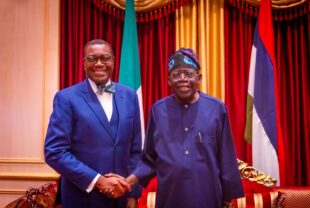
President Tinubu, in his remarks at the ceremony, celebrated Olanipekun’s fifty years in legal practice and conferred on him the Grand Commander of the Order of the Niger, Nigeria’s second-highest national honour, in recognition of his service to the nation and the legal profession.
The President described Olanipekun’s loyalty not as a matter of chance, but as earned trust built over decades of friendship, commitment, and reciprocity. Reflecting on their long-standing working relationship, Tinubu remarked that while friends in politics often come and go, Olanipekun had remained steadfast at the helm of his legal team through some of the most defining legal contests of his political career, several of which are chronicled in the newly unveiled six-volume compendium.
Tinubu also highlighted Olanipekun’s unmatched record in Nigerian presidential election litigation, noting that the senior lawyer had led the legal teams that defended three of his predecessors whenever their elections were challenged, making him lead counsel to four successive Nigerian Presidents since 2007. Praising Olanipekun’s influence on Nigerian jurisprudence and mentorship of younger practitioners—including two of his biological children who have attained the rank of Senior Advocate of Nigeria—the President remarked that while many lawyers cite the law reports, Olanipekun’s work is etched directly inside them.
Turning to governance and the rule of law, President Tinubu used the occasion to assure the judiciary that his administration respects court judgments, including rulings it does not find palatable, and will never denigrate, attack, or intimidate judges.
He maintained that a government that bullies its judges weakens its own foundation, adding that an independent, competent, and trustworthy judiciary is indispensable to protecting citizens’ rights and attracting domestic and foreign investment. Emphasizing that investors read court judgments just as closely as they read balance sheets, Tinubu declared that contracts in Nigeria must remain sacred rather than seasonal, and that every timely judicial decision serves as a strong advertisement for the Nigerian economy.
Adding a note of political humour as attention gradually turns toward the 2027 general elections, the President joked that opposition politicians who had faced Olanipekun in court might view the book presentation as an uncomfortable reunion with past legal defeats.
He disclosed that he had funded complimentary sets of the six-volume publication for delivery to several figures in the opposition so they could revisit familiar courtroom battles, before offering a light-hearted warning ahead of 2027 that rivals in future electoral disputes would need to look elsewhere for counsel because Olanipekun was already taken and booked.
Olanipekun, who previously served as Attorney-General and Commissioner for Justice of the old Ondo State, President of the Nigerian Bar Association in 2002, and Chairman of the Body of Benchers between 2022 and 2023, also holds prominent roles in higher education governance, including serving as Pro-Chancellor and Chairman of the Governing Council of the University of Lagos.
The Abuja ceremony underscored the enduring intersection between Nigeria’s courtroom history and its democratic evolution, linking Tinubu’s early 1992 legislative aspirations with the constitutional and political milestones that followed.