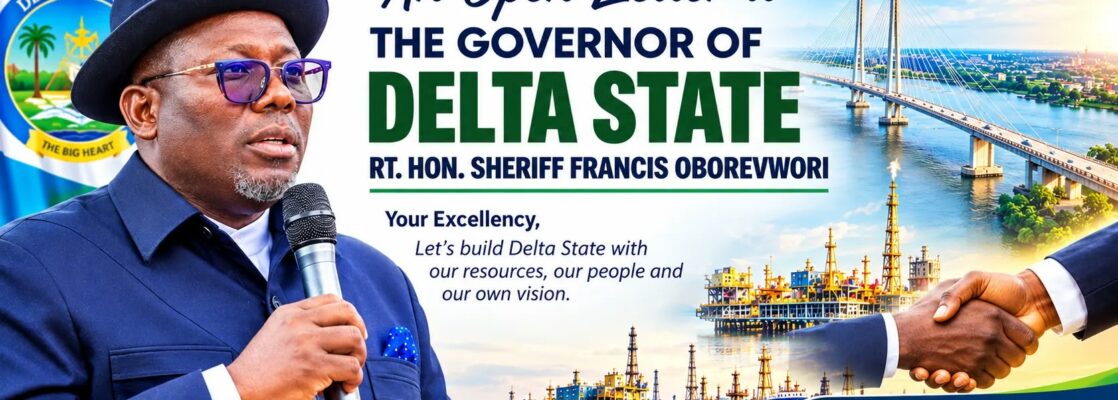
Human rights activist, PhD research fellow at Middlesex University, London, and Founder/CEO of Legal Supporters, SRTV Media, and SRTV Film Academy, Ogbevire Christian Ashaiku (popularly known as Daddy Kris), has issued an open letter to the Governor of Delta State, Rt. Hon. Sheriff Francis Oborevwori, calling for a radical overhaul of the state’s foreign investment framework.
In the detailed letter addressed to the state chief executive, Ashaiku cautioned that while foreign direct investment remains crucial for economic growth, job creation, and industrial expansion, unstructured foreign partnerships risk subjecting the state to economic colonization.
Highlighting historical experiences in the Niger Delta region, Ashaiku cited the operations of multinational oil giants including Shell, Chevron, and Total. He noted that while these entities generated employment, the ultimate profits were repatriated overseas, leaving local host communities without the technical skills or self-sustaining infrastructure needed to build indigenous industries after decades of oil extraction.
To prevent a recurrence of past mistakes, the activist urged the Delta State Government to adopt international economic models such as China’s foreign investment policy. He pointed out that China mandates a 51 percent local equity stake in foreign ventures—such as Volkswagen China—while enforcing mandatory local workforce integration to guarantee a seamless transfer of technical expertise.
Ashaiku questioned whether the Oborevwori administration has established concrete safeguards and structural conditions to safeguard the state’s economic future. He argued that Deltans, alongside federal, state, and local government entities, should be the primary investors driving key economic projects before foreign capital is sought.
On capital mobilization and capacity building, the media executive cited examples such as the expansion of Dangote Group and historical initiatives like Marcus Garvey’s Black Star Line to show that local capital can be mobilized. He proposed an investment hierarchy that gives first refusal to Deltans, followed by Nigerians and Africans, before opening opportunities to international investors.
Addressing potential talent and technical shortages, Ashaiku advised the government to establish a structured skilled workers scheme for foreign experts—modeled after international migration frameworks such as the United Kingdom’s system—to fill immediate gaps without surrendering local equity or administrative control.
The activist urged Governor Oborevwori to make the state’s economic and investment plan publicly accessible by publishing it on the official Delta State website. He stressed that public digital platforms belong to the citizens and should serve as an inclusive master plan that all Deltans can align with.
Ashaiku expressed optimism that numerous resourceful Deltans, Nigerians, and Africans, both at home and in the diaspora, possess the financial capacity, expertise, and willingness to partner with the state government on equitable terms.
He reiterated the readiness of citizens to collaborate with the administration to build an independent, prosperous, and self-sustaining economy for Delta State.
You Might Also Like