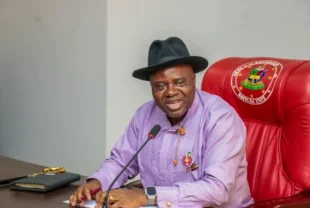

Bayelsa State Governor, Senator Douye Diri, has strongly countered former Cross River State Governor Donald Duke over his recent remarks claiming that the 700km Lagos-Calabar Coastal Highway project is unfeasible due to the region’s vast swampy terrain.
Duke had asserted during a television interview that the project was “unbuildable,” arguing that traversing Bayelsa State and its capital, Yenagoa, would require constructing hundreds of bridges through deep swamps.
Faulting Duke’s perspective, Governor Diri expressed disappointment over the former governor’s statements, maintaining that modern engineering solutions have long overcome the challenging geographical landscape of the Niger Delta.
”To say the least, I feel disappointed that former Governor Duke, who is from our region, made such a comment,” Diri stated through his Chief Press Secretary.
“Clearly, he is not abreast of current developments in road construction and infrastructure development in our state.”
Diri highlighted several major infrastructural achievements built directly over terrain similar to the coastal highway path, including dualized routes in New Yenagoa City and the Glory Drive project, as evidence that swampy topographies present no barrier to modern construction.
”Dualised roads in New Yenagoa City, the dualised Glory Drive Phase 1, 2, and 3 were all built through forest and swamps,” Diri added. “Yenagoa is not what Duke described it. So, he is wrong. The Lagos-Calabar coastal road is buildable and possible”.
Cautioning against the politicization of critical economic developments, Governor Diri emphasized that the multi-state highway will serve as a game-changer for unlocking commercial potential across riverine communities in the South-South and South-West regions.
The 700km Lagos-Calabar Coastal Highway project is designed to span nine coastal states—Lagos, Ogun, Ondo, Edo, Delta, Bayelsa, Rivers, Akwa Ibom, and Cross River—aiming to dramatically reduce regional travel times and boost maritime trade connections.
You Might Also Like